
Baseline Main Street, illustrative clinic
Same-Day Access Simulator
How much same‑day access do I need?
Run six scenarios at a five-doctor clinic and see how to optimize capacity across same-day access, full schedules and patient continuity.
The problem
Patients need same-day care. How many slots should we set aside for it each day?
6 slots, 3 patients: 3 slots sit empty.
3 slots, 6 patients: 3 can’t get in.
Meet Main Street Family Medicine
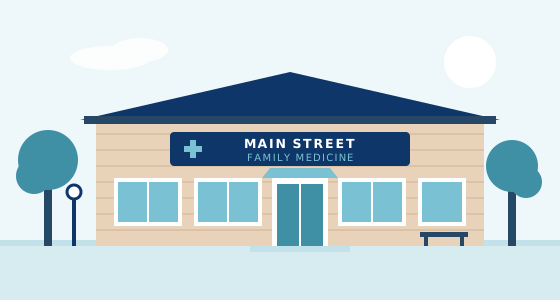
Illustrative clinicOne clinic with five primary care physicians. Each doctor sees only their own patients. It is a made-up clinic, and every number is illustrative.
Each doctor works 8 to 5 with lunch from 12 to 1 and uses 20-minute slots. 24 slots a day.
For a month the team counted every same-day request: phone calls, portal messages the triage nurse said needed a visit, and walk-ins at the front desk. They found 4 same-day requests per doctor, per day, on average.
 Dr. Adams
 Dr. Brooks
 Dr. Chen
 Dr. Diaz
 Dr. Evans
So how many same-day slots should each doctor hold?
What we’ll measure
- Template utilizationAn empty slot is a visit that didn’t happen.
- AccessEveryone else waits, goes to the ER, or gives up.
- ContinuityHow often patients are seeing their own doctor.
What we’ll test
- BaselineSame for everyoneSame number of slots for every doctor, every day.
- 1By doctorEach doctor holds slots for their own average.
- 2By doctor and daySlots follow the week too: more on Monday, fewer on Friday.
- 3Prioritize accessEnough slots for at least 95% of same-day patients.
- 4See each other’s patientsIf your own doctor is full, the next open doctor sees you.
- 5Walk-in providerA walk-in provider takes the same-day line.
Skip the walk-through and see every result side by side.
How this works
Each run plays a full year at Main Street: 230 clinic days. Each doctor’s same-day requests vary from day to day around their own average, and Mondays run busier. We show you the first week, day by day, then the year’s totals.
When the doctors share one same-day line, one doctor’s busy day fills another doctor’s quiet day.
Scoreboard
Discussion
1. Access, template utilization, continuity: pick two.
- Continuity + utilizationOwn doctor, few slots, patients come up short.
- Continuity + accessOwn doctor, slots for the busy days, slots sit empty.
- Access + utilizationOne shared line, walk-in or urgent care, continuity drops.
There is no right answer, only a choice. Which one is your organization giving up today? Did you choose it?
Access: patients seen when they need it. Template utilization: slots get used. Continuity: patients see their own doctor.
2. Panel size implications
Panel capacity = Visits a yearVisits per patient
- Empty slots are lost visits.Fewer visits delivered means fewer patients the schedule can carry.
- Moving the sick visits off the doctor’s schedulemeans each patient needs fewer visits from their own doctor, so each doctor can carry more patients, if someone else sees them.
How we got this
- Each doctor has 24 visits a day, 230 clinic days a year.
- Booked-ahead slots are always full. A same-day slot counts only if someone used it.
- Each patient makes 3.0 visits a year, 0.5 of them same-day sick visits. (Illustrative assumptions.)
- Panel capacity = visits the doctors deliver in a year ÷ visits per patient.
- In Scenario 5 every doctor slot is booked ahead, and sick visits happen at the walk-in, so each patient needs 2.5 visits a year from their own doctor, not 3.0.
Try your own Illustrative clinic
Want to see this on your own clinic’s numbers?
Tell us a little about your clinic and we’ll follow up.
Ready to talk now? Book a call
Thanks.
We got your message and will be in touch.